Tuesday, January 20, 2015

Easing of US Restrictions Promises Better Lives for Cubans

Beginning with a trickle and then growing rapidly, a steady flow of money into Cuba will be the first tangible effect of normalized US-Cuban relations. With more cash reaching the island’s impoverished citizens comes hope for a better life, something all Cubans desperately want.

Cubans typically earn only $20 per month so that tips from visitors rank just below remittances as a financial lifeline.

Like the communists in China, the overriding objective of Cuba’s communist party is retaining power. But unlike the Chinese who have concluded that higher living standards derived from economic freedom is the recipe for preserving one party rule, Cuba’s leaders haven’t made that determination.

“Cuba’s communists are going through an identity crisis, not knowing what they want,” says John Kavulich of the US-Cuba Trade and Economic Council.  He says the ruling party views itself as still under US attack and fears the income inequality that would result from a freer market.

Kavulich says it was economic desperation that led Raul Castro to agree to the normalization with the US that was announced in mid-December. Cuba, he says, is essentially bankrupt with huge debts that it can’t pay. With the collapse of oil prices, Venezuela has cut back on transfers, aggravating Cuba’s financial distress.

While US companies can now sell to Cuba, the ban on financing for Cuban importers remains. Most business transactions will be cash only, a significant impediment particularly to US food and agricultural firms eager to expand in the Cuban market.

Trade lawyer Robert Muse doubts that congress will repeal the 55-year-old trade embargo this year. He concedes that President Obama has wide authority to use executive action to resume trade and travel but says the ban on financing is a huge constraint. 

Kavulich, a frequent visitor to Havana, believes  “Cuba will allow in only what it thinks it can control.”  Permitting travel and lifting of the ban on credit card use are positive moves but the island is not being thrown open to US trade and investment. US Visitors still have to obtain visas to enter Cuba and normal tourism is still banned under terms of the embargo that only congress can lift. Havana has a limited tourist infrastructure with few restaurants and hotels that meet western standards.

Before there can be widespread investment American firms have $5 billion of outstanding claims that have to be resolved.

Since Raul Castro succeeded his brother Fidel as president in 2008 Cuba has initiated modest economic reforms.  Cubans can now buy and sell their cars, homes and apartments. During a visit to Havana this month I was surprised to see occasional “for sale” and “for rent” signs.  Small-scale entrepreneurship is beginning to take hold.  

Rental apartments in Old Town Havana

While the charm of once grand but decaying buildings, 1950’s automobiles, the absence of advertising and US-style fast food may be compelling, prospective visitors should scale back their expectations. Internet service is spotty. English-language newspapers aren’t available. Those vintage cars can’t be exported.

What visitors will find is a vibrant Cuban culture, great music, friendly people and a receptivity to Americans.

Marco Rubio, the Cuban-American senator from Florida, believes the loosening of  US travel and trade restrictions creates “a windfall for the Castro regime that will be used to fund its repression against Cubans.”  Short-term there may be truth in his assertion but long-term Rubio is certainly wrong.

Like people everywhere Cubans crave freedom and that quest will not endear them to the Cuban communist party. Equally Cubans value their independence and are proud of their revolution’s accomplishments.    

But the risks of normalization rest primarily with Cuba’s rulers. Their country is changing and the lifting of US trade restrictions deprives the communists of a powerful weapon, that the embargo is the cause of all of Cuba’s problems.   

Tuesday, January 13, 2015

A Look at Cuba Before Normalization Takes Hold

HAVANA, CUBA: In light of the historic thaw in US Cuban relations announced on December 17th, three items stand out from a four-day visit to Havana:  1/ Cuba’s economy is a disaster in desperate need of reform. 2/ The communist party retains its tight grip and political change is a long way off. 3/It is likely to be months before normalized bi-lateral relations produce real change.

The Economy

 Havana is a ruin, a surreal time warp, exemplified by ancient cars and trucks from before the 1959 revolution. For 50 years there’s been no imports of cars for private use.  Houses and apartment buildings are run down with their occupants not having cash for needed repairs. 

Amazingly, most Cubans subsist on salaries of $20 per month.  Those with more are communist bureaucrats, workers in tourism with access to hard currency, and those receiving remittances from abroad.

Cuba’s economy is dead in the water with barely any advance in gdp. The country is nearly bankrupt with no access to credit. There are frequent power outages. Unemployment is kept low because jobs are provided in a bloated and inefficient public sector where four out of five Cubans work. Inflation is suppressed. There are chronic shortages. Basic foodstuffs are rationed. Ninety percent of Cubans don’t own a car.

Despite the negatives, reforms unveiled in 2011 by President Raul Castro have allowed a small but growing private sector to take hold. The reforms permit Cubans to buy and sell their apartments, 84% of which are privately owned. But while an incipient real estate market exists, it is stymied by an absence of mortgage credit.

Similarly, Cubans can buy and sell their privately owned vehicles. But contrary to expectations liberalization has boosted car prices. Unbelievably, the asking price on the refurbished 1956 Chevrolet pictured below is well over $100,000. Classic cars can’t be exported, meaning that US-based collectors won’t be able to import these treasures anytime soon.

Restored 1956 Chevrolet on Havana’s Prado

Cuba’s economy is further distorted by there being two currencies, both of which circulate. The government says unifying the exchange rate is a priority but that is unlikely to occur until Cuba obtains access to hard currency. Look for early moves for Havana to rejoin the International Monetary Fund.

A Closed Political System

Cuba remains a one-party communist state with little prospect of liberalization. The media is tightly controlled and state-owned newspapers are mostly propaganda. English language newspapers from abroad are banned.

This past week Cuba released more of the 53 political prisoners it promised to liberate as part of the December accord between presidents Obama and Castro. Thirty-six are now free, a move the White House calls “a tangible sign that Cuba is keeping its word.”

As part of the 2011 reforms Cubans can have cell phones, stay in hotels previously reserved for tourists, use the internet, and travel abroad. But because most people don’t have disposable income, the new freedoms mainly help the better off.

Contrary to what many outsiders want to believe, Fidel, his brother Raul and the revolution remain popular, although independent surveys don’t exist. Cubans are proud of their country’s achievements in education and health care, which is free to all.

Change from Normalization May be Slow

 Every Cuban of the two-dozen or so I spoke with favors normalization. Some were deeply emotional, saying they can’t wait for Americans to arrive in significant numbers. The lives of ordinary people are bound to improve with the lifting of the embargo.

But while Cubans and Americans are eager for visits, important restrictions remain. Despite President Obama’s announcement, it is still not possible to use US-issued credit cards in Cuba. Likewise getting email on dial up internet servers can be difficult.  I was unable to access my Google and Yahoo email accounts, getting instead a prompt saying, “access is denied in the country you’re in.” There is disagreement whether these measures can be lifted by executive order or must await congressional action.

Bob Corker, the new chairman of the Senate Foreign Relations Committee, said last week that the embargo has been ineffective, a clear sign that he may favor its repeal. Both the Chamber of Commerce and leading agricultural organizations favor normalization. Congressional hearings are already planned and a top state department official is visiting Havana this month to advance the normalization process.

A Cuban businessman, who declines being identified, told me that Cuba urgently requires reform.  “We’ve created a system,” he said, “that we can’t control.”  The only way for us to have any prospect of economic improvement, he continued, is to open up and build a market economy.

Last May Washington’s Peterson Institute for International Economics released a study on the Cuban economy.  In it researcher Gary Hufbauer concluded “that once the tectonic plates shift” there will clear benefits for both Cuba and the United States.  The tectonic plates have shifted and from my perspective Hufbauer is spot on.#


Barry D. Wood writes often about economic transitions. He last visited Cuba 11 years ago. This piece appeared first on market watch.com.

Friday, December 19, 2014

Globalization and the Australian Car Industry

It’s been a devastating 18 months for the Australian auto industry and its 50, 000 workers. One by one, the country’s automakers declared that without import protection they couldn’t be profitable and had to close.

Ford is the first to go.  Its local CEO Bob Graziano observed that Australian manufacturing costs are four times Asian levels and double those of Europe.  Having lost $600 million over five years, he said local production would end in 2016.  Ford has made cars in Australia since 1925.

General Motors Holden, the biggest manufacturer, will cease Australian production in 2017. And Akio Toyoda told Toyota workers near Melbourne that with current and future free trade agreements, “it is not viable to continue building cars in Australia.” Toyota’s modern Australian plant will close in two years.

Analysts say economies of scale killed the Australian auto industry. With only 23 million people and a vehicle market that barely exceeds 1 million sales annually, unfettered competition did in high cost domestic manufacturers.

Successive Australian governments have embraced globalization and abandoned the discredited import substitution model of economic development.  Domestic producers used to be protected by quotas and tariffs that in the mid-1990s were as high as 30%. Market opening measures brought auto tariffs down 2.5% each year to their current 5% level.  To soften the effects of competition the government lavished hug subsidies on domestic producers but they are being phased out.

Low tariffs triggered a surge of lower priced imports, which now dominate the market. Even with the car market growing and the local economy booming, domestic car production fell by 50% over the past decade. Last year a mere 210, 000 cars were produced in Australia, an amount equal to the output from a single assembly plant in many places. Domestics now account for less than 18 % of the Australian auto market.

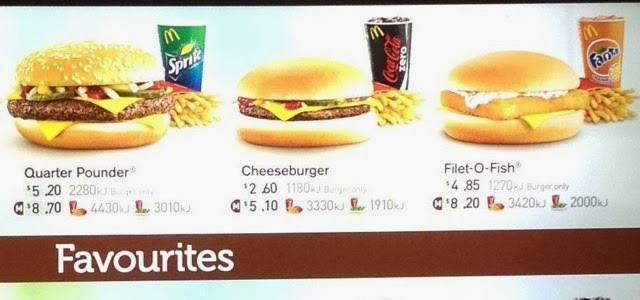
As foreign visitors know well, Australia is a high cost economy. During my two-week visit in November, I was shocked to pay $8 for a hamburger and fish sandwich at McDonalds, or $6 for a donut and coffee at Krispy Kreme, and $20 for a burger and beer at a Brisbane restaurant.

A McDonalds menu in Adelaide, South Australia

Australian autoworkers—those still working--are well paid. Many earn over $100,000 per year and even with the recent depreciation of the Australian currency, the basic industry wage exceeds $20 per hour.  Australia’s minimum wage is US $15 per hour.

Australia is a treasure chest of minerals. China is its biggest trading partner and after hosting last month’s G20 summit in Brisbane, Prime Minister Tony Abbott signed a landmark free trade agreement with China’s president Xi Jinping.

Riding the commodities boom of the 1990 and 2000s, Australia got rich from exporting iron ore, coal and natural gas.  Unemployment remains low and Australia hasn’t had a recession in 20 years. On a per capita basis it is one of the world’s 20 richest countries.

But with the commodity boom over, Australia faces a growing competitiveness problem. Because of strong capital inflows from mining, the Australian dollar rose to levels well beyond what could be sustained. The Aussie dollar soared well above parity with the US dollar, making the cost differential even more severe.  Since 2013 that trend has reversed and the Aussie dollar has recently given up half of its 40% advance of the past decade.

But even at current levels, Australia is uncompetitive.  The Boston Consulting Group designates Australia as the worst-performer of 25 economies in its global manufacturing cost-competitiveness index. Manufacturing costs in Australia, it says, are higher than in Germany, Holland and even Switzerland. Manufacturing wages, it says, rose 48% over the past decade while productivity fell.

Australia has become a service and resources economy, or as former GM Australia CEO Mike Devereux bluntly put it, Australia is now “a farm, a hotel and a quarry.”

Manufacturing has a bleak future in the land down under. But some observers, lamenting the passing of the Australian auto industry, wonder how did it manage to survive as long as it did? 

(this story originally appeared on marketwatch.com)


Cuba's Dual Currency System Complicates Needed Reforms

Che Guevara, the global icon whose revolutionary image adorns millions of tee shirts, was governor of the Cuban central bank from 1959 to 1961. While stopping short of his fanciful notion of abolishing money, the Argentine-born communist did nationalize all farms and industries, a measure that bedevils the island 55 years later.


Cuba’s economy is a wreck. Most of the island’s 13 million inhabitants are impoverished, earning the equivalent of $20 a month. Food is in short supply with rice, beans and coffee rationed. Meat is a rarity for many. Cuba is broke, with foreign debts it is unable to repay.

Living standards according to researchers at Washington’s Brookings Institution have stagnated for two decades.  Even Fidel Castro admits the failure of socialism, declaring in 2010, “the Cuban model doesn’t even work for us any more.”

The 2014 Index of Economic Freedom from the Wall Street Journal and Heritage Foundation ranks Cuba as second to last in its assessment of 178 countries.  The three lowest ranked countries are Zimbabwe, Cuba and North Korea.

When the Soviet Union collapsed in 1991 Cuba lost its financial benefactor.  Desperate for foreign exchange, Fidel Castro opened Cuba to tourism, an industry he had denounced as parasitic during the previous three decades. Sun-seeking European, Latin American and Canadian tourists flocked to the island bringing with them the hard currency Cuba so badly needed.  Cuba today couldn’t survive without tourism.

In 1994 Cuba unveiled a two-tier currency system that remains operational. Tourists are compelled to convert their money at the artificial rate of one dollar to one convertible peso. Ordinary Cubans meanwhile use the national peso whose exchange rate is not 1:1 but a more realistic 25:1.  Two legal currencies, the convertible peso and national peso, freely circulate.

The dual currency system has led to immense distortions. Since remittances from abroad total $2 billion annually, if you’re getting dollars from relatives in Miami you can live well because that cash becomes convertible pesos. In a form of economic apartheid, shops with the scarce consumer goods that people want accept only convertible pesos.

As was the case in communist Eastern Europe, those with access to foreign currency—hotel maids, bellboys, drivers-- do well while the masses suffer with national pesos. A common complaint is the absurdity of being paid in national pesos while needing convertible pesos to buy goods you need.

During a seven-day visit to Cuba some years back, I experienced the anomalies of the two-currency system. Using public transport to travel the ten miles from downtown Havana to Ernest Hemingway’s home in San Francisco de Paula, I paid the bus fare in national pesos, less than one US cent.  At the Hemingway museum the $3 entrance fee had to be paid in convertible pesos.  Inside staff furtively cajoled visitors to buy with dollars Che Guevara commemorative coins. Later dining in a private home permitted to serve tourists, the owner disclosed that he earned more in one night than he did in a month in his job as a veterinarian.   

Not surprisingly the dual currency system is deeply unpopular and Raul Castro, who succeeded his brother in 2006, promises to phase it out. But how can this be done without triggering social unrest? No one knows what the Cuban peso is really worth.

Two bicyclists I met on the Havana waterfront who had grown up in communist East Germany had an insightful perspective on the Cuban revolution.  They had traveled three weeks cycling the entire circumference of the island.  They were shocked at the poverty they witnessed but said that everywhere people retained pride in the long ago revolution. Cubans, they said, were justifiably proud of their achievements in health care and education.

I think the normalization of US Cuban relations poses significant risks for the island’s communist rulers.  For decades they pointed to the US economic embargo as the reason living standards remain low. That argument will fall away and the authorities will be left with the dysfunctional system they created.

Can Raul Castro manage the kinds of market-based reforms essential for Cuban economic growth? His record thus far suggests he can’t.  Since taking power he has zigged and zagged, trying one thing, then another, never following through.

In 2011 Raul Castro said half a million workers would be dismissed from money losing state enterprises. It hasn’t happened. Cubans can now own cell phones and use the tourist hotels that were previously off limits. So what, if the police state apparatus remains intact?  The media is still tightly controlled.  Promised moves on property rights and private business have been tentative.

 Cuba is a big deal in the Caribbean and Latin America. With 11 million people and a landmass greater than the other Caribbean islands combined, Cuba could be a regional powerhouse.

As Canadian Prime Minister Stephen Harper observes, normalization of US Cuban relations is long overdue. Fundamental change at last appears to be underway but Cuba’s future is very uncertain. 


Sunday, November 9, 2014

Missing from the Celebration of Freedom—Two Leaders Who Died Too Soon

BRISBANE, AUSTRALIA:  As the world marked the 25th anniversary of freedom returning to Eastern Europe, it is sad that two of the wisest post-communisleaders are no longer with us.

In the extraordinary events that followed the collapse of the Berlin Wall, Poland was the inspiration. It had elected a non-communist government months before the wall came down. Lech Walesa, Pope John Paul II are true heroes who changed the world. Ronald Reagan’s strong stance and his 1987 call to “tear down this wall” were similarly decisive. Mikhail Gorbachev, the last Soviet leader-- still alive at 83—courageously allowed the wall to be opened, sacrificing in the process Moscow’s loyalist East German communists. 

Comprehending the enormity of Gorbachev’s deed, an astonished British editorialist wrote that, “all of Stalin’s war time territorial gains in Europe were given up without a shot being fired.”

Events cascaded rapidly. Czechoslovakia’s communist government collapsed within days after the wall came down. Hungary catapulted towards free elections while the remaining regimes-- Romania, Bulgaria and Albania-- toppled like a row of dominoes.  In 1990 East Germans voted to merge their country with West Germany. And late in 1991 the USSR itself collapsed, fragmenting into 15 separate countries.

History, in my opinion, will judge Vaclav Havel of the Czech Republic and Lennart Meri of Estonia the most significant leaders to have emerged from the wreckage of communism.

Meri, Estonia’s president from 1992 to 2001, deserves recognition. Born into a prominent family, when the Red Army invaded in 1940, 12 year-old Meri, his mother and younger brother were exiled via prison train to the Siberian gulags. His father, an Estonian diplomat, had to endure Moscow’s infamous Lubyanka prison. Miraculously the family survived and later Lennart was permitted to attend university. He became a respected writer and filmmaker. He was 60 when the Wall came down.

Meri earned the admiration of Estonians during the failed coup against Gorbachev in August 1991. With his countrymen terrified that a Russian invasion would soon snuff out their drive for independence, Meri took to the radio, assuring citizens they needn’t worry, that he knew the plotters to be clueless and incompetent. There was no invasion and Meri’s grandfatherly counsel had enormous impact. 

Fluent in six languages, most learned as a youth during his father’s postings abroad, Meri repeatedly observed that the end of communism was a beginning, not an end. A tall, dignified man, Meri understood the horror of mass deportation. But remarkably he championed the cause of freedom for Russians. He died in 2006. Were he alive today Meri would be aghast at Russian actions in Ukraine, and equally comforted that Estonia’s security is anchored in Nato and European Union membership.


Lennart Meri as president

Vaclav Havel, like Meri, for five decades was deprived of the honest, authentic life he so passionately wanted. Like tens of thousands, he had to make the best of a bad situation.


Like Meri, Havel paid a heavy price for coming from an entrepreneurial family that after the communist takeover in 1948 was denounced as a class enemy. Coming of age during the period of maximum repression, he was banned from universities.  In 1975 he wrote a devastating critique of totalitarianism. In six pages Havel dissected the massive fraud and corruption of communism. Its lofty ideals, he wrote, were hollow.

Reflecting on the 1989 Velvet Revolution in Czechoslovakia, Havel explained to an audience at the World Economic Forum in 1992 how Soviet imperialism imploded.

"Communism was not defeated by military force, but by life, by the human spirit, by conscience…. It was defeated by a revolt of color, authenticity,.. and human individuality."

Famous for his essay on the power of the powerless, Havel lived to see the society where imperfectly, “truth and love prevail over hate and lies.”


Vaclav Havel

Universally hailed as a great European, Havel the dissident playwright spent years in communist jails before being swept to the Prague Castle in the Velvet Revolution. He served as president first of Czechoslovakia and then the Czech Republic from 1989 to until 2003.  Vaclav Havel died at age 75 in 2011.  Writer Anne Applebaum hails Havel’s unique success in making the transition from dissident to national leader.

Alan Levy, the founding editor of the Prague Post, was asked why Prague had become the in spot for émigré young Americans in the 1990s. He replied that he himself had pondered the question, why Prague instead of Berlin, the place that exemplified both the wall and freedom. “Prague,” he concluded, “became the Mecca for young people because of one man, Vaclav Havel. It was Havel’s example of intelligence, modesty, artistry and love that drew people to Prague.”

Havel and Meri, I suspect, would both celebrate 25 years of freedom, while warning of the obvious dangers ahead.


Barry D. Wood covered the collapse of communism and the rebuilding of Eastern Europe for Voice of America. A version of this article appeared on marketwatch.com


Saturday, October 11, 2014

Poland's Extraordinary Transformation


WASHINGTON:  Twenty-five years ago this autumn two remarkable events took place in Washington.

On September 27th, 1989 in the musty embassy ballroom of the Polish People’s Republic on upper 16th Street, Leszek Balcerowicz, finance minister in the new non-communist government, outlined a plan to transform Poland’s economy from communism to capitalism. Shock therapy would be launched in three months.

Balcerowicz’s message was breathtaking.  Prices would be decontrolled, individuals allowed to start businesses, the survival of state enterprises determined by the market. There was more-- the printing press would be shut down—halting hyperinflation, the worthless Polish currency redeemed.

Financial journalists in Washington for the annual meeting of the International Monetary Fund were astonished.  Some sprang from their seats to file stories after the modest man in the ill-fitting East European suit stopped talking. For those of us remaining the room was electric. One reporter said, “there are lots of books about transforming capitalism to communism, none for going the opposite direction.”

This was six weeks before the Berlin Wall came down.

On October 19th, 34-year-old Jeffrey Sachs, the Harvard economist advising the Polish government, made an emotional plea to Washington insiders. At a Willard Hotel dinner arranged by the Institute for International Economics, Sachs said Poland required a cash injection to “leap across the chasm” from disintegrating communism to capitalism. “The next six months,” he said, “are critical in determining whether Eastern Europe’s first non-communist government since World War II succeeds.”

Sachs had made his name by helping to end hyperinflation in Bolivia. He essentially shamed his Washington audience into action, excoriating the US government, the IMF and World Bank for dragging their feet.  It was imperative, he said, that the Polish experiment succeed.

The debate over big bang and shock therapy essentially began that night.

Sachs had offered his services to Poland only weeks earlier and was just off the plane from Warsaw where there was chaos and anger over shortages of basic commodities, including food. Few outsiders thought the planned reforms-- that in the short-term would further depress living standards—had any chance of working. Sachs said later, "It was a terrifying and unpredictable period."

The rest, of course, is history. Not only did the Balcerowicz reforms stabilize and activate the economy, they won critical public and government backing. They became a model for similar plans in Czechoslovakia and the Baltics (where they worked) and in Russia (where they failed).

What could not be foreseen in the autumn of 1989 was that Poland would become the star performer of all the economies that emerged from the wreckage of the Soviet empire. Poland’s return to growth and fiscal discipline were powerful factors in the European Union agreeing to admit eight former communist countries in 2004.

Balcerowicz, now 67, served as finance minister and then central bank chief until 2007. Currently he teaches at the economics university and runs his own research institute.

While Poland has not yet joined the euro currency zone, Balcerowicz subscribes to the fiscal austerity doctrines championed by Germany. He faults Greece and other southern periphery countries for not moving fast enough or hard enough to restructure their uncompetitive economies.

The Polish miracle continues.  Alone among European Union economies it did not experience a downturn following the 2008 financial crisis. In most recent years Poland has been the fastest growing economy in the EU. Its gross domestic product has doubled since 1989 and is today Europe’s sixth largest economy.

More significantly, per capita g.d.p. has more than doubled since 1989.  This in a country of nearly 40 million, by far the largest in Eastern Europe.


Poland and Germany—with a long history of conflict—have become partners, demonstrated most recently by Chancellor Angela Merkel championing the selection of conservative Polish  Prime Minister Donald Tusk as the new president of the EU council. 

Reflecting on the 25th anniversary of his reforms, Balcerowicz credits Sachs with playing a vital role in persuading the Solidarity-led government that shock therapy was the best way forward. For his part, Sachs says he is "thrilled that the Poles acquitted themselves so beautifully in the pages of history."


Thursday, September 25, 2014

South Africa’s Nuclear Agreement with Russia Raises Questions


WASHINGTON: On the sidelines of a conference in Vienna on September 22d, South Africa signed an agreement for Russian nuclear power plants to be built in the country. The deal could be worth $50billion.


Signing ceremony in Vienna: South African Energy Minister Tina Joemat-Pettersson and Rosatom CEO Sergei Kirienko (photo: Rosatom)

Assuming the deal goes forward, they would be the first Russian nuclear reactors in Africa, joining the continent’s sole nuclear facility, the French-built Koeberg power station near Cape Town. 

South Africa badly needs additional generating capacity. Its power grid is overstretched and rolling brown outs have become common. The African National Congress (ANC) government has long favored additional nuclear plants to augment coal-fired facilities. The Russians would build eight VVER reactors with a combined output of 9.6 giga watts by 2030. It would be one of South Africa’s biggest infrastructure projects.

The opposition Democratic Alliance is calling for details of the strategic partnership agreement to be made public. The South African energy department says the accord is preliminary and that constitutionally mandated procurement procedures will be followed.

With the government having a history of shady business transactions, the Russian nuclear deal has set off alarm bells in the South African media. Commentators are calling attention to President Jacob Zuma’s surprise five-day visit to Russia last month, for which no official program was released.  It is known that Zuma met with President Vladimir Putin but it is not known if the nuclear framework was discussed.

Zuma is already under fire for financial irregularities in a $20 million upgrade to his private residence.  In 1999, long before he became president, there were charges of kickbacks to ANC officials-- including Zuma—as part of a $5 billion arms deal with Sweden.

Following the ANC’s victory in last May’s parliamentary election, Zuma reshuffled his cabinet, surprising analysts by elevating his lightly regarded agriculture and fisheries minister, Tina Joemat-Pettersson to the energy portfolio. Last year Ms. Joemat-Pettersson, a communist from Kimberly in the Northern Cape, was investigated for unethical conduct after awarding a fisheries contract to a company  inked to the ANC but with  no experience in commercial fishing. She turned aside opposition calls to resign.

At the signing ceremony in Vienna, Ms. Joemat-Pettersson said the accord “opens the door for South Africa to access Russian technology, funding and infrastructure.”

By signing with Rosatom, South Africa is ignoring the punitive sanctions levied against Russia by Europe, America and Japan to protest Moscow’s intervention in Ukraine. While in Washington in early August for President Obama’s African Leaders Summit, Mr. Zuma called for increased US investment in South Africa.  The Westinghouse unit of Japan’s Toshiba, as well as French and Chinese firms, have wanted to build nuclear plants in South Africa, but analysts say the Russian technology is cheaper.

South Africa is the leading beneficiary of AGOA, the African Growth and Opportunities Act, that allows most African products duty-free entry into the US market.